
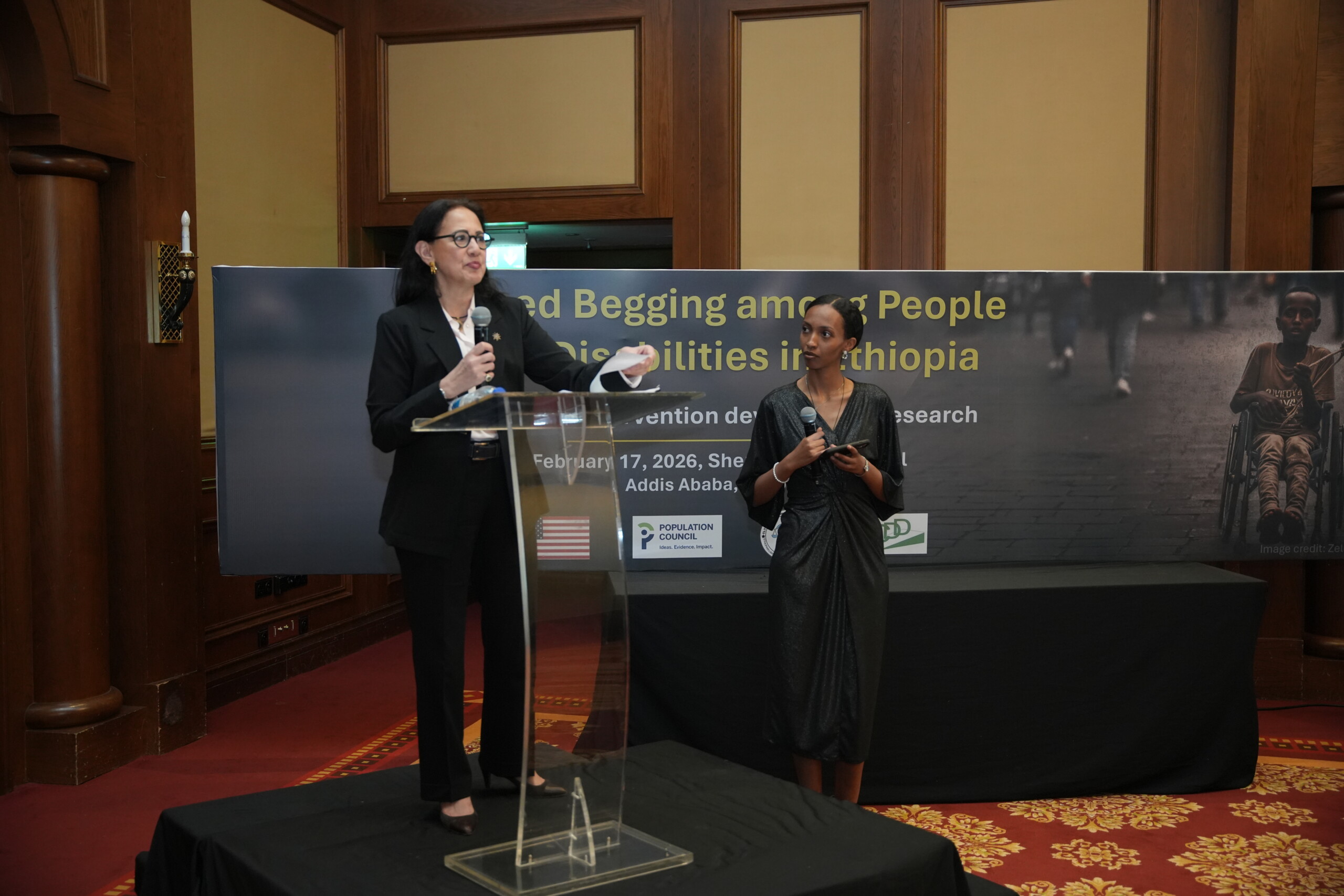
Annabel Erulkar, Senior Associate, has led an intervention development research (IDR)* project since 2024 on addressing the trafficking of vulnerable populations in Ethiopia. In February 2026, the Council published Hiding in Plain Sight, the first-ever study on the nature and patterns of forced begging of persons with disabilities based on this ongoing research.
For World Day Against Trafficking in Persons, Annabel spoke with us about forced begging, how this type of human trafficking occurs, and how the Council and partners in Ethiopia are developing interventions to combat trafficking, facilitate rescue, and provide support to victims.
*IDR in human trafficking is the equivalent of research and development (R&D) in medicine or product design. IDR is a systematic effort to specify what an intervention should do, for whom, through what mechanisms of change, and how the local context will shape whether it works. This detailed and systematic process is all done before any piloting or evaluation.
Tell me more about forced begging as a form of human trafficking — what is it and how does it happen?
Forced begging happens when a trafficker uses force, fraud, or coercion to put a person in begging for the trafficker’s financial gain. The victims of forced begging are typically vulnerable people including very poor, rural children; orphans from a rural area; children with disabilities; and older people who are fully dependent on others.
In some cases, children can be kidnapped and brought to the city and forced to beg. Other times rural parents can be convinced by a trafficker that they will show the child a better life in the city, such as sending them to school.
What insights have you gained since you’ve started researching this form of trafficking?
The accounts of extreme violence and threats were striking. Many of the survivors were beaten daily, living in terrible conditions, near-starving, and even threatened with their lives.
Some of the survivors we interviewed had been purposely disabled and made blind by their traffickers. The children taken at a very young age that are threatened and manipulated found it very hard to even tell concerned strangers or law enforcement about what is being done to them — such was the degree of the brutality they faced.
On top of this, young children, many of whom are living with a disability, feared being abandoned in these urban areas where they had no familiarity, no family, and no support systems. This is another factor that keeps them silent about the abuse they’re experiencing and makes it difficult for law enforcement or other authorities to investigate these cases.
Earlier this year, your team published “Hiding in Plain Sight,” a report detailing the initial findings of this project. How has this research informed action?
We found that members of the public often observed violence between the traffickers and the victims.
It’s often these members of the public — such as people passing by in the street or a neighbor or a bus driver — who observe suspicious activities and bring in law enforcement. As such, we are raising awareness of forced begging through a media campaign and establishing an anonymous hotline in Addis Ababa which members of the public can call and report suspicious activities.
What happens when someone calls the hotline?
After receiving a hotline report, our partners from Ethiopian Lawyers with Disabilities Association (ELDA) will go out to identify the case and inform law enforcement of the report for further investigation. ELDA is also building the capacity of public prosecutors and other members of civil service to more effectively identify victims of forced begging.
The victims of this form of trafficking face a great deal of trauma and need medical, mental health, and rehabilitative care. We are partnering with Ethiopian Center for Disabilities and Development (ECDD) to oversee the case management of rescued victims. We also partner with a range of existing shelters in Addis Ababa which have been upgraded to be accessible for people with disabilities. The victims we rescue are housed in these shelters and receive the support and care they need.
For a highly vulnerable population like this, how have you had to adjust research approaches to make sure no one was put in greater danger?
This issue has received little attention, and, to date, very little information is available. Our project is considered “intervention development research” which means that research, stocktaking, documentation and adaptation are woven throughout every aspect of the program.
We have utilized new research approaches to ensure we did not put vulnerable populations at further risk. We conducted ‘hotspot’ enumerations, a novel research approach where we observed hotspot areas where large numbers of people in begging congregated to gain a greater understanding of the dynamics of those areas. We observed how people in begging interacted with people accompanying them or transporting them to the ‘hotspot’ locations — essentially people who were potential traffickers. We also interviewed survivors of forced begging and purposefully identified survivors who had been rescued or exited trafficking several years prior.
This was done to minimize the chances of re-traumatization or retaliation. Of course, we also had counselors available in case our research participants required their support. This research was explicitly and deliberately designed around the physical, emotional, and safety needs of the survivors, which is an approach that will be critically important for future research in this area.
Do you think this kind of trafficking occurs elsewhere? What can other countries take from these learnings?
This is one of the first projects of its kind to address forced begging. Several people contacted me after the report came out and described how forced begging takes place in their countries as well. There is tremendous scope to translate lessons learned to other contexts, keeping in mind the need to adhere to the utmost ethical approaches and safeguarding of participants.
This project is funded by the U.S. Department of State’s Office to Monitor and Combat Trafficking in Persons as part of its Program to End Modern Slavery (PEMS) with technical assistance from NORC at University of Chicago. The opinions, findings, and conclusions stated herein are those of the author and do not necessarily reflect those of the United States Department of State or University of Chicago.