

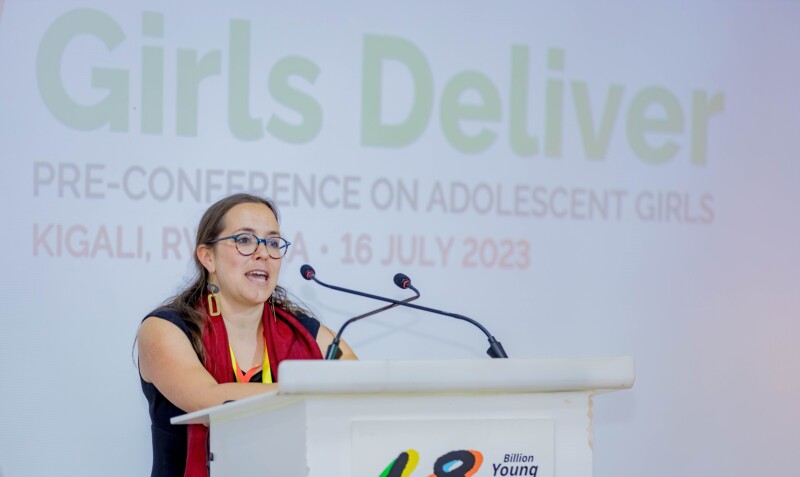
Karen Austrian, director of the Council's GIRL Center, shares why she's looking forward to Women Deliver 2026, what the Girls Deliver community brings to the conference, and how the GIRL Center ensures that girl-focused research remains part of the global agenda.
You're about to head to Australia for this year's Women Deliver conference. What are you most looking forward to?
Women Deliver is exciting. It's the biggest gathering of people working on gender equality issues, and I'm looking forward to connecting with people who bring different perspectives to the same issues. It has been a tough year for the gender equality community and being able to connect, re-energize, and not feel alone in this work is important.
What are you hoping to learn from your fellow attendees?
As a researcher, it's always great to be in a space with non-researchers to hear where the field is and to see how data and evidence around adolescent girls are being used — or not used. This informs the work we do and helps us answer whether our research is relevant and, more critically, whether it is being applied to improve girls' lives.
The GIRL Center is one of the organizers of Girls Deliver—what does the Girls Deliver community bring to Women Deliver?
Very often in gender equality spaces, you will hear the phrase women and girls, and they get lumped together. Having the Girls Deliver community carves out a space to elevate adolescent girls' voices and to distinguish their distinct needs from those of women. The fact that this is happening at Women Deliver is a real achievement of the work many of us — researchers, advocates, and the girls themselves — have been doing to elevate girls' unique issues and needs.
There are about 30 adolescent girls participating in the Girls Deliver pre-conference, and every session has an adolescent girl speaker, so we'll be hearing and learning directly from them.
The GIRL Center shapes global discourse on what works (or doesn't) to improve lives for adolescent girls. How do you ensure that girl-focused research remains part of the global agenda?
We remain active in networks such as Girls Deliver and the Coalition on Adolescent Girls so we are continually hearing from girls on what they need, as well as maintaining our ongoing relationships with government representatives and donors in this space.
We also make sure that the evidence and research we're doing is responsive to the questions that are being asked. We try to be catalytic and think ahead to the issues we see coming so when those issues are at the forefront, we're ready with evidence, data, and insights.
Can you provide a recent example of how the GIRL Center has done this?
At the Women Deliver conference three years ago in Kigali, Rwanda there was a lot of discussion around how investing in the care economy provides a pathway to gender equality since caretakers are largely a feminized workforce.
With our lens at the GIRL Center, we pushed to talk about women and adolescent girls separately. For adolescent girls to be involved in care work, it is inherently at the expense of their education. And when girls don't stay in school, we know that they are more likely to be married or have a child early.
We did reviews of the literature to test our hypotheses on how care work affects girls, and we've done secondary analysis to understand the cost to girls involved in care work. We're also doing primary data collection to understand the experience of girls working as child domestic workers in East Africa and thinking about how that plugs into advocacy efforts.
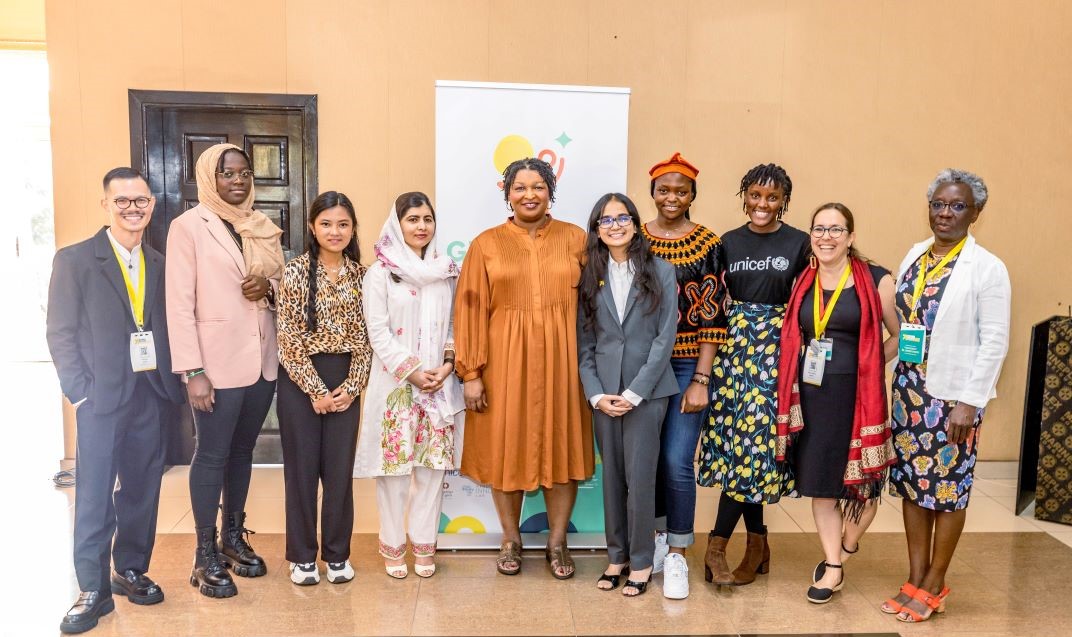
The 2023 Girls Deliver pre-conference featured youth advocates, researchers, advocates, and policymakers.
You'll be speaking on a plenary session focused on adolescent girls during this year's conference — what do you think is critical to get across to your audience?
To the credit of a lot of people working very hard in the sector, we know what works in a lot of contexts to keep girls in school, to prevent teenage pregnancy, and to prevent child marriage. This is now the time to commit to unlock large-scale financing to run programs we know are cost effective and work.
The other message that I want to convey is that girls are not a homogeneous group. There are many sub-segments of adolescent girls that are still left behind, including migrants, adolescent mothers, and girls living in humanitarian settings. There are regions, such as Francophone West Africa, where there has been almost no progress on issues like child marriage or girl schooling that still need a lot of focus.
Understanding that heterogeneity among adolescent girls is important, especially as we move towards these large-scale programs. Those sub-segments of marginalized girls will continue to need tailored approaches.
Anything else you're excited about?
It's great to be able to connect with people in person. Often, a lot of this work gets done virtually, and so it is always nice to have time to spend together, to reflect, and to commit.
See you in Narrm!